
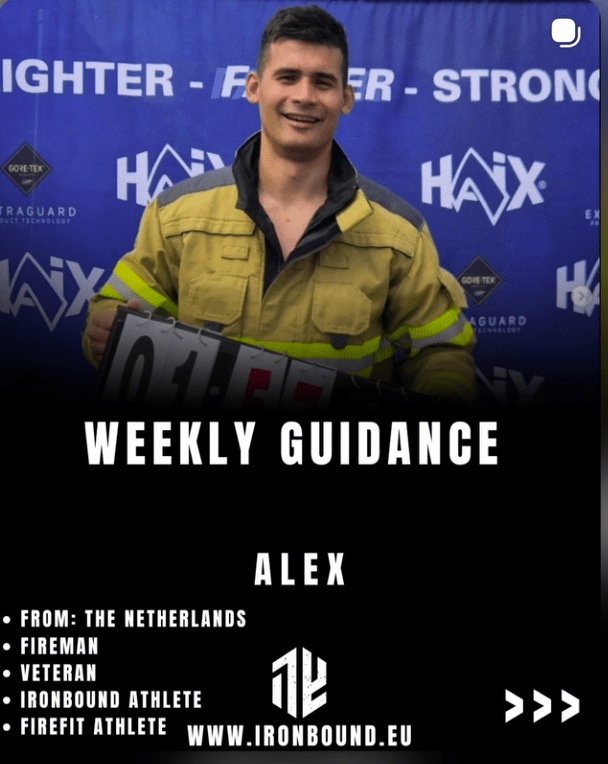

Alex: "People won't remember how fast you were. They'll remember whether they could count on you"
Fireman, veteran, husband, and father. Alex is a busy athlete who competes in FireFit competitions alongside his job as a firefighter and raising a family. In this interview, he opens up about the mentality behind it — and what actually drives him.
For me, it starts with having a winning mindset toward yourself. Discipline and motivation are important, but in the end it's about constantly wanting to become better than you were yesterday. Don't focus on what everyone else is doing. Ask yourself where you can still improve and where you can gain time.
That requires honesty. You have to be willing to look critically at yourself, identify your biggest weaknesses, and deliberately train the areas that still hold you back. The time you have should be invested strategically in improving what matters most.
Every race is a new benchmark for me. Ideally, each run is faster than the last. If that's not the case because you slipped or took too much risk, that's part of the sport. But if you're slower because you weren't physically prepared, then your training process needs to improve. That constant drive to become better is what separates good athletes from great ones.
The moment that taught me the most about staying calm under pressure was during my first deployment. We were positioned at a forward operating post when we came under heavy attack. At the same time, two suicide bombers drove into the main base and detonated themselves at the entrance. We were the next line of defense and knew it could be our turn if the first perimeter was breached.
In moments like that, you don't rely on courage — you rely on your training. The skills and drills you've repeated for years take over. Your mind doesn't necessarily become calmer; it becomes sharper. The key is making sound decisions despite the pressure. I still carry that lesson with me every day, both as a firefighter and in everyday life.
Under pressure, everyone wants to move faster, but often the most valuable thing you can do is take a second to step back, assess the situation, understand the risks, and then act. In the fire service, we call that STOP: pause, observe, plan, then execute. Although the situations are completely different, the feeling is surprisingly similar. In the military, you're facing an enemy. As a firefighter, you're facing one of nature's most powerful elements. In both situations, you're reminded how small you are and how quickly your instincts take over.
The biggest mistake beginners make is trying to train everything at once. They put on their turnout gear, run the full course over and over, and assume that more is always better. I made the exact same mistake when I started.
Real progress begins when you analyze your race. Where are you losing time? Which obstacles drain the most energy? And perhaps the most important question: are you willing to be honest about your biggest weakness?
I once heard the quote, "Your breakthrough lies in what you avoid." That has stayed with me ever since. Everyone enjoys training the things they're already good at. But the areas you tend to avoid are usually where the biggest improvements are waiting. For me, that was single-leg strength. I knew it was a weakness, yet I always found reasons to focus on conditioning or endurance instead.
The biggest lesson the fire service has taught me is that you need to have your own fundamentals in order before you can truly contribute to a team. If you don't know your equipment, your techniques, or your role, your problem quickly becomes someone else's problem.
That doesn't just apply to firefighting or the military — it applies everywhere. In any high-pressure environment, it's immediately obvious who takes responsibility for their own development. No one expects you to know everything, but people do expect you to take ownership of what you don't know and work to improve it.
I spent years working in the corporate world before becoming a firefighter, and I saw the exact same pattern there. The best colleagues weren't always the smartest or the most experienced. They were the people who took responsibility instead of waiting for someone else to solve the problem.
If there's one lesson I've taken from the military, the corporate world, and the fire service, it's that people always make the difference. Equipment, systems, and technology matter, but in the end, success comes down to the people you work alongside.
I've experienced situations in all three worlds that you hope never happen. You witness human suffering, see people under extreme pressure, and quickly learn what truly matters. It gives you perspective and makes many everyday problems seem smaller.
Maybe that's the biggest change I've gone through myself. Earlier in my career, I was mainly focused on achievement and career progression. Those things still matter to me, but today I know why they matter. My biggest motivation is my family. Thanks to shift work, I get to watch my daughter grow up and be present during moments many fathers miss because they're at work. That's something I never take for granted.
If you want to become someone people can rely on, you have to accept that there are no shortcuts. There's no book, article, or formula that suddenly makes you reliable or resilient. Strong qualities are built through the choices you make every single day.
Being dependable means doing what's required even when no one is watching. Training when you don't feel like it. Taking responsibility for your own development. Keeping your word. Discipline isn't a feeling — it's a habit.
But perhaps even more importantly, you have to be willing to put the team's interests ahead of your own at times. The people you can rely on most aren't usually the loudest in the room. They're the ones who notice when someone needs help, ask, "Are you doing okay?" and then actually do something about it.
And if you truly want to become a better athlete, your lifestyle has to reflect that goal. You can't pursue elite performance with the habits of someone treating it as a hobby. Eating well, sleeping well, recovering properly, and training consistently aren't occasional choices — they become part of who you are.