
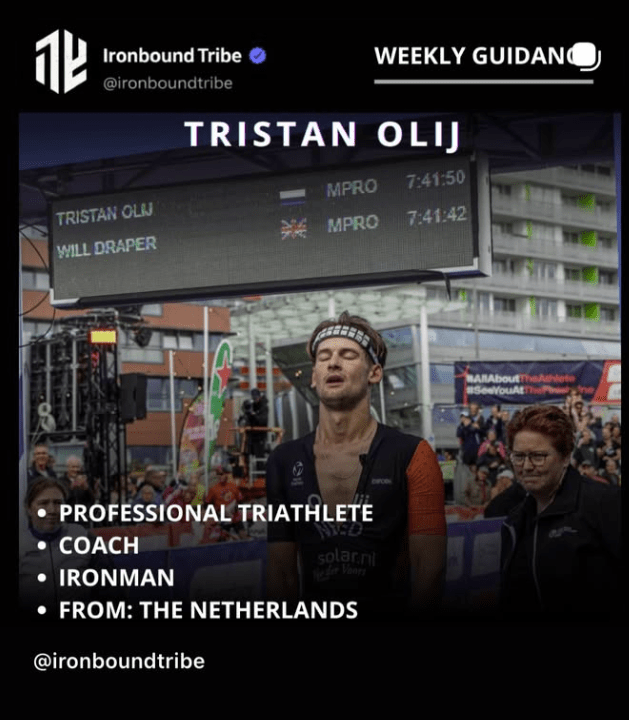

Tristan Olij: "Consistency matters more than extremes"
Tristan Olij is a 27-year-old professional triathlete and coach, competing at the top level of Ironman racing for the past six of his nine years in the sport. He trains 25 to 33 hours a week and races Ironman events worldwide. After making his Kona debut in 2024 — finishing 22nd — and securing 2nd place at the European Long Distance Championship last season, his focus now shifts to Ironman South Africa, where qualification for this year's World Championship begins.
It took years to build this. You make your body more resilient step by step. For me, it starts with consciously choosing what not to train — not every session needs to be hard. I work with a clear weekly structure where every session has a specific purpose. By doing a lot of controlled training, I can handle high volume without overloading.
Combined with proper nutrition, sufficient energy intake, and proper recovery, this allows me to keep progressing. I do very little strength training, mainly for injury prevention, and I work closely with a coach to reflect and adjust.
I'm currently on a training camp in Gran Canaria and this week I'll be training around 33.5 hours. Coming from the Netherlands, where winter limits cycling volume, the main focus here is on the bike. I ride roughly 20 hours per week, alongside about 90 kilometers of running and around 28 kilometers of swimming.
These are the heavy weeks of my season, which is exactly why nutrition becomes critical. I intentionally eat a high-carbohydrate diet to replace the large energy losses and to allow my body to handle this volume while continuing to recover.
I rarely struggle with a lack of motivation. For me, the drive comes from the daily process — training in beautiful places and trying to become just a little better each day. The path toward a big goal, the entire journey, is just as valuable to me as the final moment itself.
Training too much at high intensity and not investing enough in a strong aerobic base. Ironman is not about going very hard once in a while, but about being able to perform efficiently for long periods of time. With the knowledge I have now, I would place even more emphasis early on on calm, high-quality endurance work and be less rushed with intensity.
I would focus on doing less races and shift all focus towards one big moment.
Structure, by far. The other factors matter as well, but training for an Ironman simply requires a high volume of hours — that's a fact. Most people do this alongside a full-time job, a family, and a social life. That's why having mental clarity, feeling good in your own skin, and minimizing stress is essential.
Structured training, week after week, ultimately makes the biggest difference and helps you find the right balance between sport and personal life.